
In the world of industrial automation and structural monitoring, the force measurement sensor is the heart of the system. However, the process of choosing a load cell is often complicated by the fact that each option has its own unique benefits and mechanical limitations. Truth be told, different load cell applications have their own special requirements that go far beyond simple weight readings.
Whether you are weighing a 100-ton silo or measuring the delicate click-force of a medical device, you should discuss load cell capacity requirements with a knowledgeable supplier in advance of making a final selection. The decision you arrive at based on specific load cell selection criteria is only one step in the overall process of implementation. Beyond the sensor itself, you must ensure you correctly installed and equipped the unit with the proper signal conditioning instrumentation; otherwise, you will not achieve the precise measurements your project demands. This comprehensive load cell selection guide is designed to help you make a more informed choice for your specific US-based industrial environment.
Deep Dive: Understand Your Application
In order to truly understand your load cell application, you must determine two things: how the measurement will be conducted and how the load will be physically applied to the sensor. The process of measurement involves a variety of vector forces, including:
- Bending: Often used in medical scales and small platform weighing.
- Compression: The most common for heavy-duty tank weighing and press-fit applications.
- Multi-axis: For complex R&D where force must be measured in X, Y, and Z planes.
- Tension: Essential for hanging scales, crane scales, and cable tension monitoring.
Load cell measurements help determine the weight of tanks, the structural integrity of bridges, and the performance of durability and break point tests in automotive manufacturing. If you are working in a laboratory setting, your needs will differ drastically from someone working in a hazardous oil and gas environment.
Define Your Capacity Requirements (The “Goldilocks” Zone)
 Determining the load cell capacity requirements is a balancing act. You need to identify the maximum amount of load capacity required for your applications, as well as the necessary minimum resolution.
The Safety Factor and Tare Weight
As you go about determining the load cell capacity, you must bear in mind extraneous factors like tare weight (the weight of the scale structure itself). To ensure you have the optimal capacity, choose a sensor that exceeds the highest expected operating load by at least 20-50%. This is your “safety buffer” against accidental overloading.
Moreover, you will need to establish which engineering units (lbs, kg, or Newtons) are required for your data acquisition. The combined stress caused by extraneous loads and moments can put a dampener on the performance of an application. Consequently, you could seriously compromise the measurement accuracy of an application if you fail to select the proper rated capacity.
Fatigue and Endurance
The majority of standard in-line sensors are ill-equipped for the possibility of constant vibration or rapid cycling. For high-endurance applications, such as materials testing machines, you must choose a sensor with an optimal fatigue rating, as specified by the manufacturer. A sensor used in a “one-off” break test has very different internal stresses than one used in a factory line performing 10,000 cycles per hour.
Define Your Physical Load Cell Needs
In order to select the right load cell, you must visualize the physical integration. Ask yourself these critical questions:
- Is the load of your application dynamic (moving) or static (stationary)?
- Do you intend to make in-line use of the load cell (integrated into a shaft or cable)?
- Do you intend to make side-mounted use of the load cell?
The mechanical design of your machinery dictates the sensor shape. Load cell capacity requirements are in part determined by the physical footprint available. Common shapes include:
- Compressor washer (for bolt force).
- Female/male thread (for easy mounting in actuators).
- Flange mount (for high stability).
- Thru-hole (for shafts to pass through).
Size, Material, and Specification Requirements
Another key component of load cell selection criteria is the definition of size and material. In the USA, many food-grade applications require Stainless Steel load cells, while lighter, cost-effective applications might use Aluminum alloy sensors.
Physical Dimensions
You must determine the needs of your application along the following measures:
- Width and height (Is there a clearance issue?).
- Weight of the sensor (Does the sensor’s own mass affect the measurement?).
- Length of the cable (Long cables can lead to signal degradation.
Technical Variances (The Data Sheet)
To ensure you have sufficient load cell performance, look closely at the metrological specifications on the data sheet:
- Bridge resistance: Usually 350 ohms or 1000 ohms.
- Hysteresis: The difference in readings when a load is applied vs. when it is removed.
- Nonlinearity: The maximum deviation of the calibration curve from a straight line.
Finally, consider the environment. Will you be working in high-temperature foundries or cryogenic labs? Likewise, load cell capacity requirements can be affected by whether applications are carried out in submerged settings (requiring IP68 or IP69K ratings) or dry factory floors. Factors such as the frequency of response and the need for NIST traceable calibration are also matters of high interest.
Select the Right Instrumentation
A load cell is useless without a “brain”. At the same time you choose a load cell, be prepared to also select the necessary electronic instrumentation. When you pick all the vital pieces — signal conditioners, digital displays, and cables — at the same time, you ensure system-wide functionality.
You should always include system calibration in your order. This ensures the load cell and instrument are calibrated as a matched pair. Load cell calibration is a vital component to all load cell applications, ensuring that the millivolt signal from the strain gauge translates accurately into pounds or kilograms on your screen.
Load cell applications
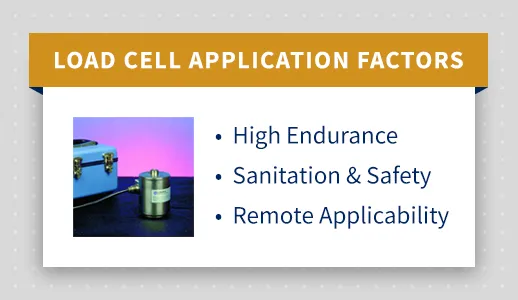 A variety of load cell options are preferable in relation to the demands of the setting or application in question. As you learn how to select the right load cell for a particular application, consider your foremost requirements. In general, the performance of a load cell will correlate to the demands of an application as follows:
- High endurance. In an industrial setting, a strain gage load cell is one of the best options, because the accuracy is near perfect in applications that involve experimental stress.
- Sanitation and safety. In applications that demand precise mechanical balance, pneumatic load cells are the more preferable option.
- Remote applicability. When an application is conducted in a remote setting, the best choice is a hydraulic load cell, which can operate without a power connection.
Load cell selection criteria — or the choice between a strain gage, pneumatic or hydraulic load cell — should largely be determined by the preceding factors.
Comparing Load Cell Technologies
Different settings demand different technologies. As you learn how to select the right load cell, consider the pros and cons of these four major types:
Strain Gauge Load Cells
The most widely used sensors in the industrial sector. They are valued for their durability, stiffness, and high resonance values. The strain gauge is a planar resistor that deforms as the metal “spring element” deforms. This change in electrical resistance is proportional to the force applied. They are the “gold standard” for general weighing.
Piezoelectric Load Cells
Unlike strain gauges, piezoelectric matter generates an actual voltage in response to deformation. These are not ideal for static weighing (as the signal “decays”), but they are incredible for dynamic force measurement, such as measuring the impact of a crash test or a hammer strike.
Hydraulic Load Cells
The hydraulic load cell works via a cylinder and diaphragm-covered piston filled with oil. As the load increases, the oil pressure increases. Because they contain no electrical components, they are the safest choice for hazardous, explosive environments (ATEX/Ex areas) or areas prone to lightning strikes.
Pneumatic Load Cells
Designed to control the balance of pressure, these use air instead of fluid. They are often found in sanitary environments where oil leaks cannot be tolerated, providing high accuracy for precise mechanical balance.
Understanding Load Cell Shapes and Use Cases
S-Beam Load Cells (Z-Beam)
 You can identify S-Beam load cells — alternately known as Z-Beam load cells — by their shape, which resembles the namesake letter. Used primarily in applications that involve tension, S-Beam load cells provide accuracy when the weighing system becomes suspended or hung. In addition to their high precision, S-Beam load cells enjoy popularity due in large part their affordability and ease of setup. However, S-Beam load cells are made exclusively for in-line applications and tend not to perform accurately with extraneous loads.
Beam Load Cells (Bending and Shear)
- Bending Beam: Best for low-capacity (1 to 500 kg) applications like bench scales.
- Shear Beam: Features an interior design that safeguards the cell from side-loading. These are the primary sensors used in floor scales and hopper weighing systems. They are typically made of nickel-plated carbon steel or stainless steel for corrosion resistance.
Canister Load Cells
The oldest design in the strain gauge family. Today, they are used for massive compression applications, such as truck scales and railroad scales, often handling 100,000 lbs to 500,000 lbs with ease.
Pancake Load Cells (Low Profile)
When precision is paramount and vertical space is limited, the pancake load cell is king. Its low-profile design makes it highly resistant to off-axis loading, making it ideal for high-precision laboratory testing.
Button and Thru-Hole Load Cells
- Button Load Cells: Extremely compact, perfect for the medical sector or robotics where space is at a premium.
- Thru-Hole (Donut): Used for measuring clamping force or bolt tension. The “Lifesaver” shape allows a bolt to pass directly through the center of the sensor.
Managing Adverse Loading Conditions
Even the best sensor will fail if you don’t account for adverse loading. Before finalizing your purchase, audit your system for these four risks:
- Overloading Capacity: Know the ultimate overload rating. If a fork truck accidentally drives over your scale, will the sensor survive?
- Dynamic Loads: If a weight is dropped onto the scale (shock loading), the instantaneous force can be 10x the static weight. Your load cell rating must account for this speed and pressure.
- Fatigue Loading: If your application cycles millions of times, the metal will eventually fail. Ensure your manufacturer provides a fatigue-rated sensor.
- Off-Axis Loading: This occurs when the load is not perfectly centered. Use load buttons or rod-end bearings to ensure the force stays on the design axis.
Why Choose Group Four Transducers?
Group Four Transducers is a leading US-based supplier of high-quality load cells used in everything from aerospace data acquisition to medical device testing. We specialize in applications involving:
- Tensile testing and torque measurement.
- Process control and overload monitoring.
- Peel force measurement for packaging.
At Group Four Transducers, we provide more than just a product; we provide custom engineering solutions. Unlike many manufacturers who only sell their own brand, we understand the entire force measurement ecosystem. We offer equipment for the manufacturing sector that prioritizes quality control and safety.
For example, our sensors help construction companies monitor crane loads to prevent catastrophic failures, while food processing plants use our sanitary load cells to ensure the perfect balance of ingredients. With capacities ranging from 0-10 grams to 0-3 million lbs, we have the scale and expertise to handle any project.
The Benefit of a Single-Source Supplier
The best way to select a load cell is to determine all necessary components—the sensor, the mount, and the instrument—at once. Buying from a single source like Group Four Transducers ensures compatibility between all parts and simplifies your technical support chain.
Contact Group Four Transducers today for more information on the best load cell for your application. Whether you need a standard S-Beam or a custom multi-axis force sensor, our team is ready to provide a quote and a solution that meets your exact specification requirements.
Conclusion: Your Path to Precision
Selecting a load cell doesn’t have to be a gamble. By defining your application environment, calculating your safety-factored capacity, and choosing the right mechanical shape, you can build a weighing system that lasts for decades. Don’t settle for “good enough” when it comes to force measurement—consult with experts who understand the nuances of strain gauge technology and industrial instrumentation.
Frequently Asked Questions
How to select the right load cell for a new industrial project?
To choose the ideal sensor, you must first define your primary measurement goal: are you measuring tension, compression, or both? A proper load cell selection guide starts with evaluating the environment (temperature, moisture), the required accuracy (nonlinearity and hysteresis), and the physical mounting constraints. Consultation with a specialist is recommended to ensure the sensor’s material—such as stainless steel for food-grade use—matches your specific industry standards.
What factors go into a professional cell capacity calculation?
A common mistake is selecting a capacity exactly equal to the maximum load. For a safe and accurate load cell capacity calculation, you must sum the maximum “Live Load” (the weight you intend to measure) and the “Dead Load” (the weight of the scale platform or tank). Finally, apply a safety buffer of 20-50% to protect the internal strain gauge from unexpected shock loads or accidental overloading
What are the most common strain gauge load cell types available?
Depending on the geometry of your application, you will likely encounter several strain gauge load cell types. S-Beam cells are the industry standard for tension and hanging scales. Shear Beam cells are preferred for floor scales and hoppers due to their resistance to side-loading. For high-capacity needs, Canister cells provide immense strength, while Pancake (low-profile) cells offer the best precision in tight vertical spaces.
Why is weighing system instrumentation just as important as the sensor?
A load cell only produces a raw millivolt signal; it requires high-quality weighing system instrumentation to translate that signal into readable data. Proper signal conditioners and digital displays ensure that the data is filtered for noise and correctly scaled. For the highest level of accuracy, we recommend “System Calibration,” where the sensor and the instrument are calibrated as a single, matched pair before installation.
How do industrial force sensors handle off-axis or side loading?
Most industrial force sensors are designed to measure force along a single primary axis. When force is applied at an angle (off-axis loading), it can lead to measurement errors or even structural failure of the sensor. To mitigate this, engineers use specialized mounting hardware like load buttons or rod-end bearings to ensure the load remains centered. If your application involves high side-loads, choosing a Pancake or Shear Beam design is often the most stable solution.